

You’ve probably had this experience before. The forecast says it’s going to be sunny, but suddenly it starts pouring, and you’re left wondering whether you should buy an umbrella.
Predicting when and how much it will rain is considered one of the most challenging problems in weather forecasting worldwide. The core difficulty lies in accurately modeling complex physical phenomena, such as cloud formation, that occur at extremely fine scales using global-scale models. Recently, however, the Google Research team unveiled a hybrid model called NeuralGCM (General Circulation Model) that aims to overcome this long-standing challenge. Let’s take a closer look.
Where AI Meets the Laws of Physics
The defining feature of NeuralGCM is its hybrid architecture, which combines a physics-based dynamical core that computes large-scale atmospheric flows with neural network–based parameterizations that model fine-grained weather phenomena. Here, “parameterization” refers to the process of estimating phenomena that are too small or too complex for models to calculate directly, such as cloud formation or the aggregation of individual raindrops, using intelligent mathematical formulations or AI.
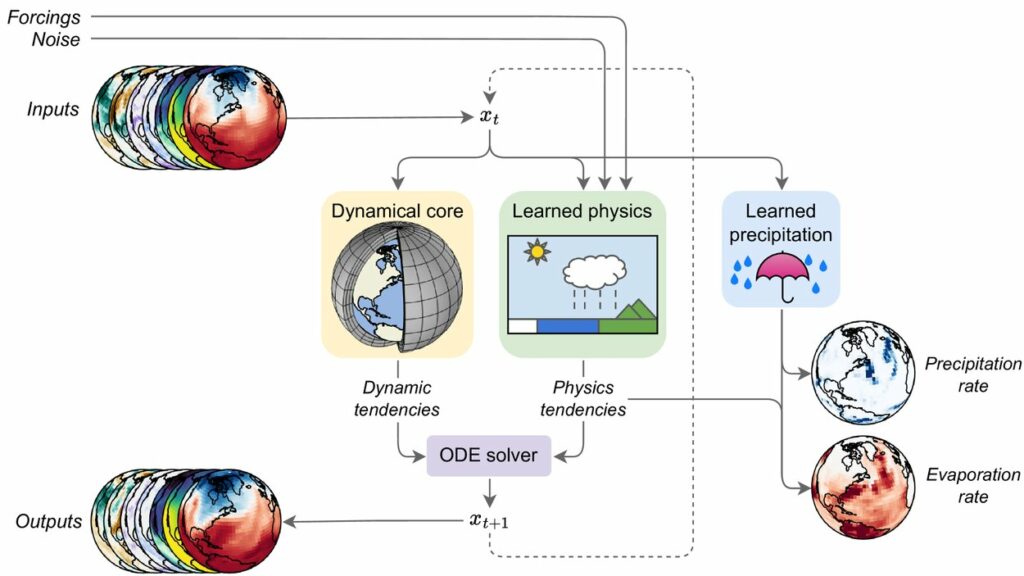
The hybrid framework architecture of NeuralGCM. Source: Google.
NeuralGCM predicts rainfall by dividing the Earth into a grid and modeling everything from the surface up to the top of the atmosphere as tall vertical columns. How was this model trained?
- Direct training on satellite observations (IMERG)
Previous hybrid models typically relied on high-resolution simulation data rather than real observations, which meant they also inherited errors from those simulations. NeuralGCM, however, is trained directly on IMERG, NASA’s satellite-based precipitation observation dataset. This allows the model to learn natural rainfall patterns more accurately and eliminates long-standing biases found in earlier approaches. - A differentiable architecture
NeuralGCM is designed to be fully differentiable from end to end. This makes it possible to compute the error between the model’s predictions and actual observations and to jointly optimize all neural network parameters through end-to-end training. In effect, the entire system operates as a single, tightly integrated learning unit. - Maintaining physical consistency
As mentioned earlier, NeuralGCM represents the Earth as grids and vertical columns, each containing information about water vapor, clouds, ice, and more. The model is explicitly constrained so that changes in water content within each column strictly follow physical laws. In other words, while AI drives the predictions, the outputs are forced to remain physically plausible, leading to higher overall accuracy.

Stay ahead in AI
NeuralGCM Results
NeuralGCM is a relatively low-resolution model that divides the entire Earth into coarse grids of approximately 280 km (2.8°). With grid cells this large, it is typically difficult to capture fine-grained weather phenomena such as clouds and rainfall. NeuralGCM overcomes this limitation by allowing neural networks to intelligently infer complex processes occurring within each grid cell. As a result, it achieves more accurate precipitation forecasts than ECMWF, currently regarded as the best-performing system that operates with much finer and denser grids.
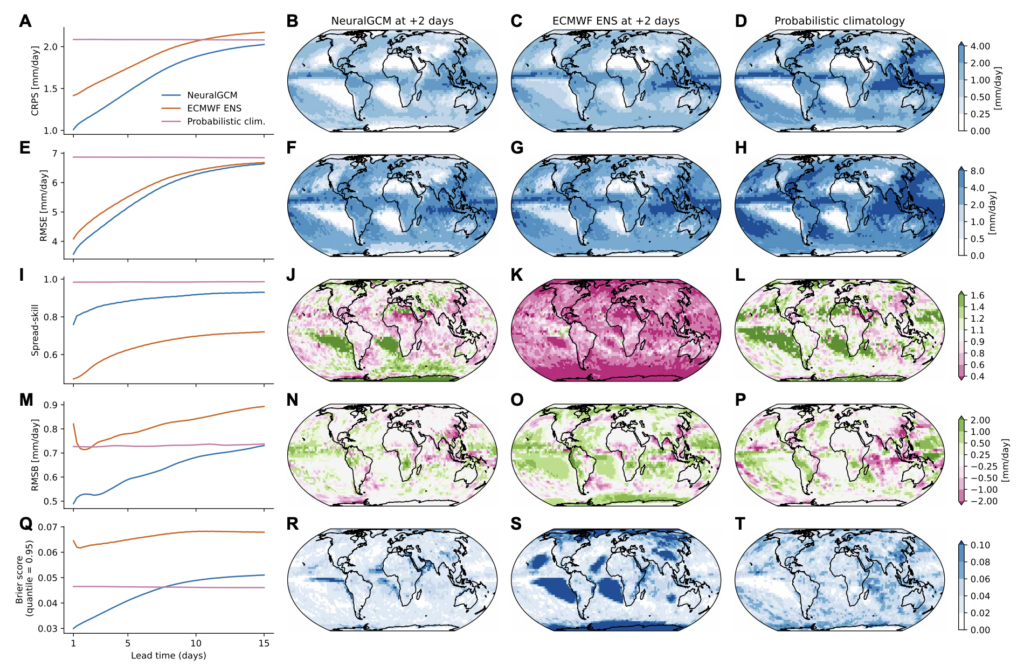
Comparison of 24-hour accumulated precipitation forecast accuracy based on IMERG satellite observations. Source: Google.
The chart and map above present a head-to-head comparison of forecasting performance between NeuralGCM and ECMWF based on data from the year 2020. Let’s take a closer look at the results:
Consistently higher accuracy:
From the start of the forecast up to 15 days out, NeuralGCM (in blue) consistently outperforms ECMWF across all metrics, including overall forecast accuracy (A), mean error (E), and extreme precipitation skill (Q).
Uniform performance:
The global map on the right shows the error distribution on day 2 of the forecast. NeuralGCM delivers low and evenly distributed errors worldwide, without being biased toward specific regions.
Remarkable speed:
NeuralGCM is also highly efficient. Using a single TPU, it can simulate approximately 1,200 years of climate data per day. This is tens of times faster than traditional weather models that rely on thousands of CPU cores.
NeuralGCM is not limited to academic research. It has already been deployed in a pilot program, in collaboration with the University of Chicago and India’s Ministry of Agriculture, to predict the onset of the Indian monsoon season. Technology truly begins to shine when it moves beyond the lab, and we look forward to 2026 as a year when more research like this makes a real, tangible impact on everyday life.